Gratitude Tree for Families: How to Make One Together, One Leaf at a Time
A gratitude tree is one of the simplest ways to help a family practice thankfulness together, and you can start one tonight with paper, a jar, and a few leaves from the yard. Have you noticed how quickly your children's eyes go to the gifts under the tree? What would happen if, this year, thankfulness arrived before the presents did?
I love the anticipation of a special season: the small hands reaching, the familiar songs, the moments our family gathers. But I also know how quickly the season can become a blur of plans, expectations, and things to do. In the middle of it all, we can make room for a simple practice that helps our children notice what God has already given.
Not a perfect craft. Not another obligation for a tired mom. Just a few minutes together to remember His goodness.
Thankfulness Can Become a Family Tradition
Scripture gives us a steady invitation: “Be thankful in all circumstances, for this is God’s will for you who belong to Christ Jesus” (1 Thessalonians 5:18, NLT). And Psalm 100:4 reminds us to “Enter His gates with thanksgiving; go into His courts with praise. Give thanks to Him and praise His name” (NLT).
These verses don’t ask us to pretend that every circumstance feels good. They invite us to bring our real lives to God and practice noticing His care within them. Gratitude isn’t a feeling we have to wait for before we begin. It’s a choice we can practice, even on an ordinary evening when dinner is simple and everyone is a little tired.
A family tradition doesn’t need to be elaborate to become meaningful. When we return to a small practice together, it gives our children a way to name the good, thank God, and remember the people who care for them. The practice itself can be brief. The memory it cultivates can last.
A Gratitude Tree Makes Thankfulness Visible
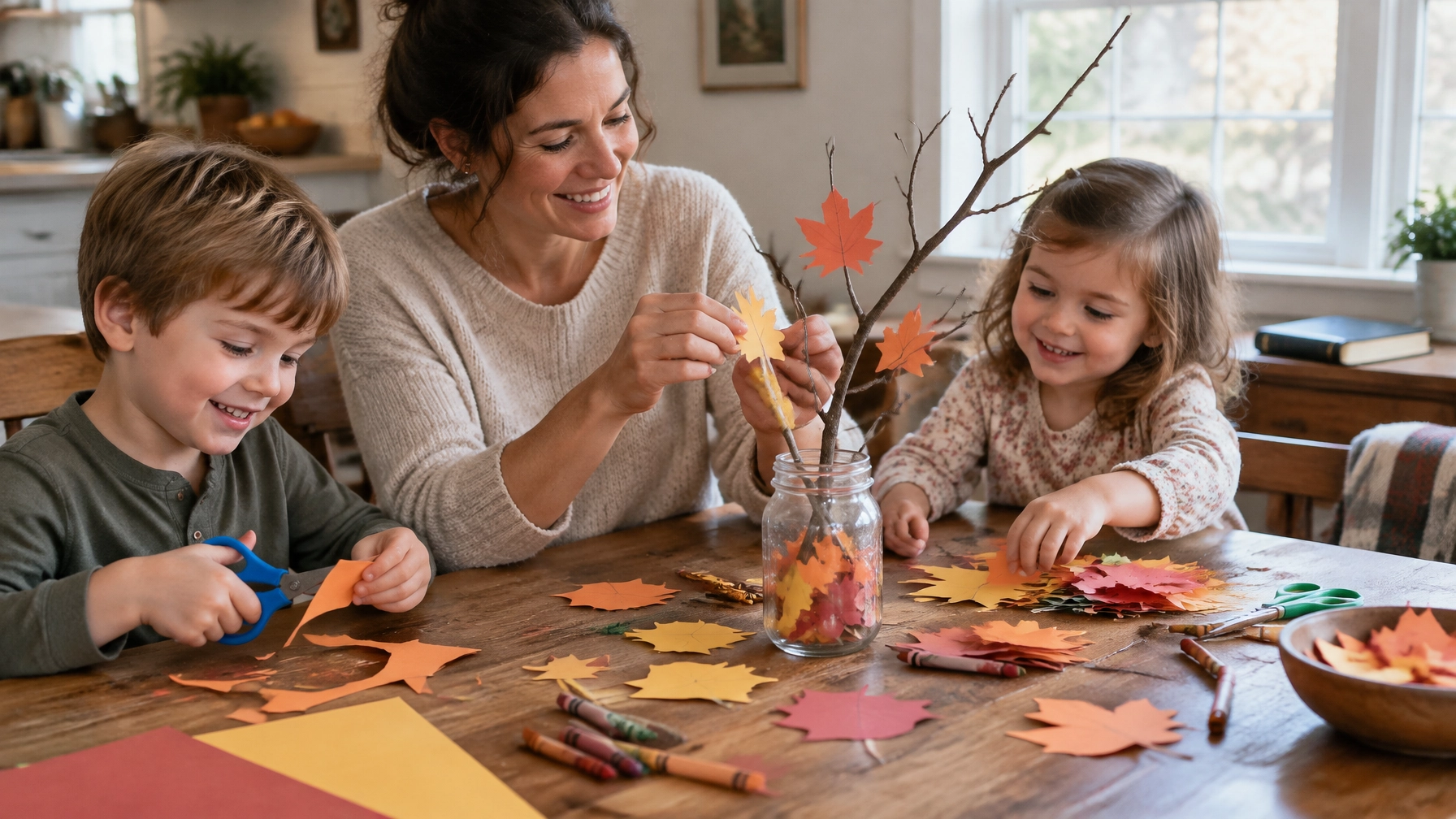
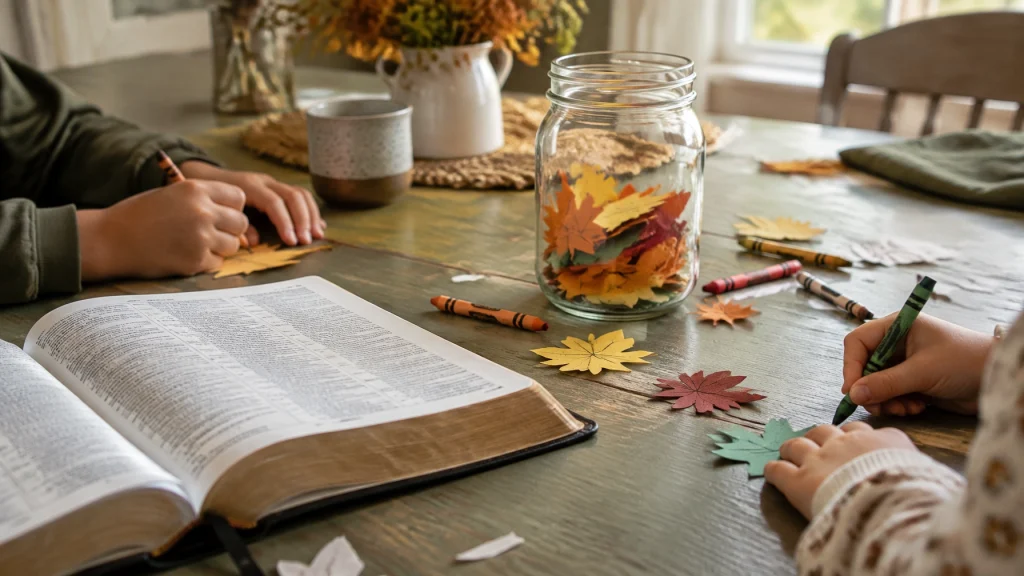
A gratitude tree can be as simple as paper leaves and a jar. If you have a branch, you can place it in a jar and hang the leaves from it. If not, tape leaves to a wall, stick them on the fridge, or gather them in a bowl. Use whatever is already in your home.
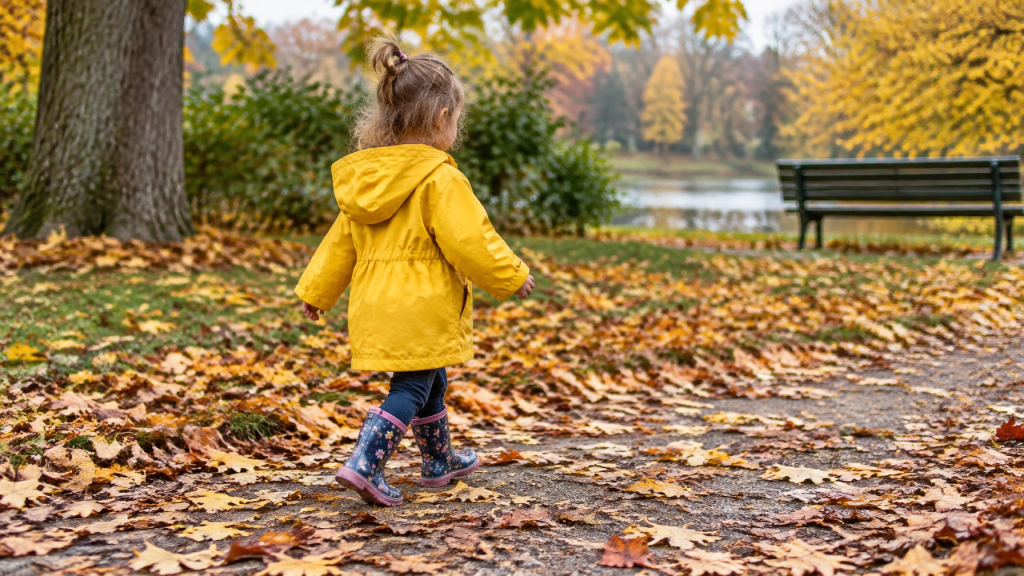
You can also gather your own leaves from outside. On a walk or right in the yard, let everyone collect a few: the crumpled ones, the bright orange ones, and the almost-perfect ones all belong on the tree. Real leaves work just as well as paper, and hunting for them together is often the part your children will remember most.
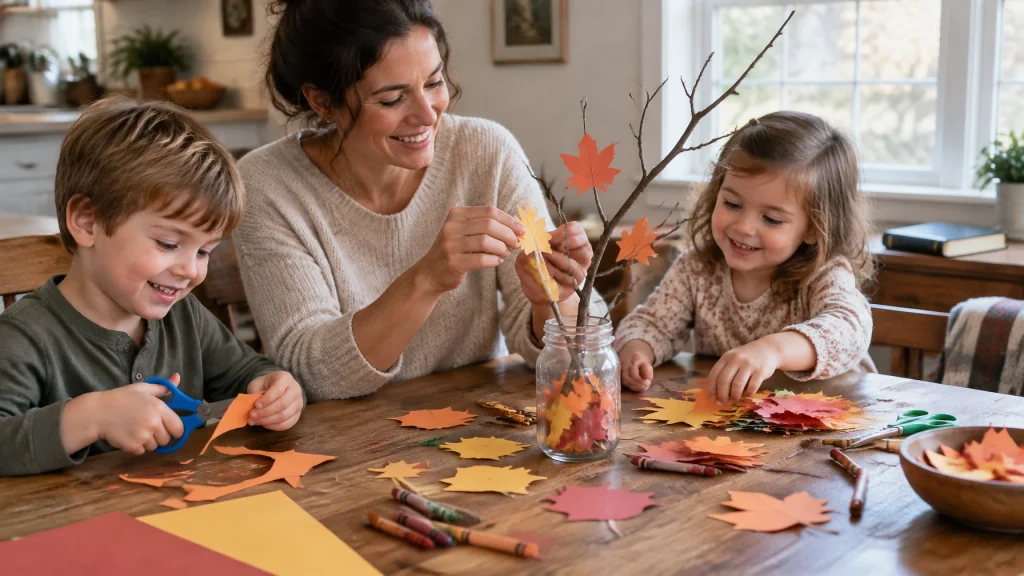
Here’s one easy way to begin:
- Cut a few leaves from paper. They can be neat, crooked, tiny, oversized, or cut out by enthusiastic little hands.
- Set out crayons or markers and invite each person to draw or write one thing they thank God for.
- If your child is too young to write, ask what they want to say and write it for them, or let them make a picture.
- Add the leaves to a jar or attach them to a branch or wall.
- Take a moment to read them aloud and thank God together.
This is meant to be fun together as a family, not a test of anyone’s creativity or a picture-perfect project. If the leaves are uneven, the table gets messy, or someone draws a banana and calls it their best blessing of the day, even better. Let the laughter belong to the tradition, too.
You don’t need a special supply run or a full afternoon. Start with what you have and let the activity stay light. The point is not to produce a beautiful tree. It’s to make space for your family to notice God’s goodness together.
Raising Thankful Children Starts With What We Model
As mothers, we want to give our children more than a list of rules about saying “thank you.” We want to help them grow into people who recognize kindness, receive what they have with humility, and express appreciation with sincerity.
That kind of learning often happens in small, everyday moments. When I name something I’m thankful for, I give my children a simple example to follow. When we thank someone who helped us, they see gratitude move beyond words. When I pause to notice a meal, a kind friend, a warm home, or a moment of rest, I show them that thankfulness can live in ordinary life.
This isn’t about getting motherhood right every day. Some evenings will be rushed. Some days will carry disappointment, grief, or exhaustion. We can be honest about what feels hard and still look for a way to name what is good. Gratitude should never be used to dismiss a child’s sadness or make anyone feel guilty for having a difficult day. We can listen first, make room for honest feelings, and gently ask what else we might thank God for.
In an upcoming episode, November 28, we will talk about raising children with thankful hearts. This article is a companion to that conversation: a simple family practice you can try in your own home. Listen to The Language of Pearls Podcast.
And if a gratitude practice at the table feels helpful, PBS Kids also offers ideas for practicing gratitude as a family. Research on parents and children has likewise explored how everyday gratitude practices and family activities relate to children’s expressions of gratitude (study in Frontiers in Psychology). A small ritual is not a guarantee of a particular outcome; it’s one loving way to practice what we hope our children will see and carry.
Five Dinner-Table Prompts Can Start Tonight
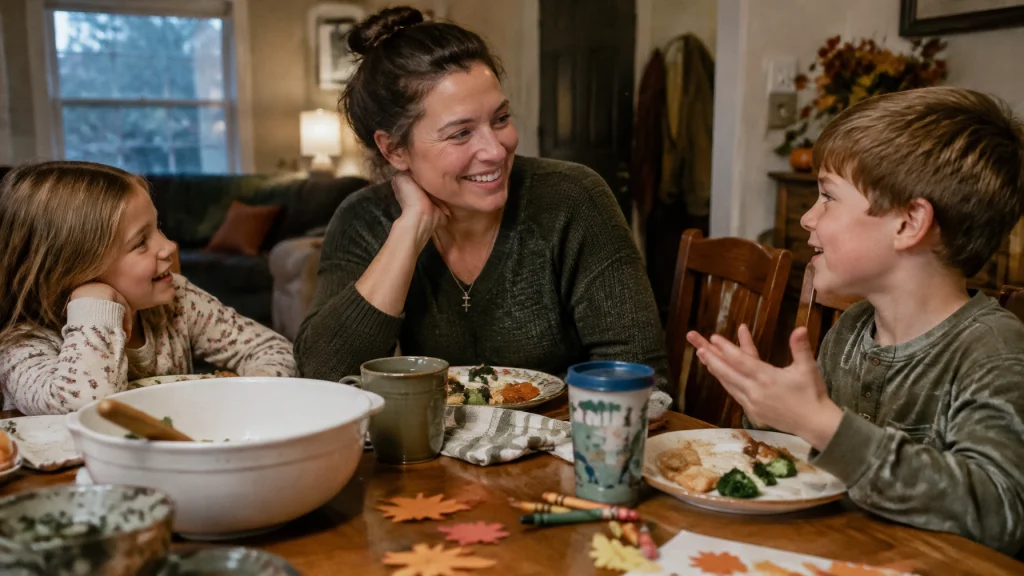
You don’t have to wait until Thanksgiving or Christmas to begin. Ask one question at dinner, invite each person to answer aloud, and make one gratitude leaf from the conversation. Let children pass if they need to. Their answers don’t need to sound profound to be worth remembering.
- What made you smile today? Let a small moment count.
- Who helped you today, and what did they do? Name the kindness, then consider how you might thank that person.
- What is something ordinary you’re glad we have? A favorite blanket, a warm meal, or a ride home all belong.
- What did God help you through today? Make room for both an honest answer and the comfort of remembering His care.
- What is one thing you want to thank God for right now? Give each family member time to choose their own answer.
If a child names the same thing several nights in a row, that’s all right. If your family only manages one leaf this week, that counts. The practice can grow slowly, at a pace that fits your real life.
Let Thankfulness Shift the Season
Before the gifts arrive, we can create a little space for wonder. We can help our children see that joy is not limited to what is waiting under the tree. It can be found in a shared meal, a kind word, a familiar prayer, and the people God has placed around us.
At DG Inspired Studios, we believe that the light of Christ that bears truth, beauty, and hope can meet us in the ordinary rhythms of family life. I believe God can use a simple gratitude practice to help us pause, breathe, and remember His faithfulness, not because the activity is perfect, but because He is present with us.
Begin where you feel the Spirit of God leading you. Make the leaves together. Ask one question tonight. Or simply thank God aloud for one small kindness before the day ends.
My prayer is that your home will have room for honesty, laughter, and a growing awareness of God’s goodness. May He give you rest when you feel weary, clarity for the next step, and courage to keep nurturing what matters. May thankfulness take root in your family, not as pressure to be cheerful, but as a shared way of remembering the One who cares for you.
I declare that nothing is impossible with God, and that He can meet your family in the ordinary moments you share.
For more encouragement, listen to The Language of Pearls Podcast. Moms can find the free Christian Mother’s God-Given Calling Guide, and every woman following God’s call is welcome to explore the free resources including our 5 Steps to Kingdom Clarity Guide here. May Christ fill your home with truth, beauty, hope, and the freedom to enjoy one another. Messy leaves and all.